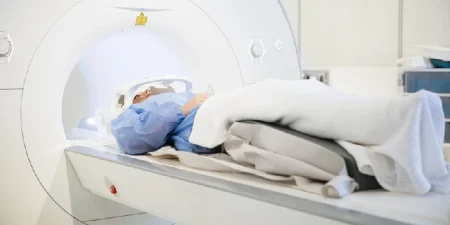
A full scan MRI, also called a full-body MRI or whole-body MRI, examines multiple body regions during one imaging session. MRI uses magnetic fields and radio waves rather than ionizing radiation. It can provide detailed images of soft tissues, organs, bones, bone marrow and selected blood vessels.
A full-body MRI may help identify abnormalities that have not yet caused obvious symptoms. However, it is not a single test for every disease. The scan protocol must be selected according to medical history, symptoms, risk factors and the reason for imaging.
Table of Contents
What Is a Full Scan MRI?
A full scan MRI is a magnetic resonance examination designed to assess several anatomical regions within the same appointment. The exact imaging area depends on the chosen protocol.
The terms full scan MRI, full-body MRI and whole-body MRI are often used interchangeably. In clinical practice, however, different centers may use different scan coverage and MRI sequences.
Many whole-body protocols cover the head, neck, chest, abdomen and pelvis. Some extend farther into the legs or include additional dedicated sequences. A scan described as “full body” does not automatically examine every organ with the detail of a dedicated MRI.
Modern protocols commonly combine anatomical MRI sequences with diffusion-weighted imaging, known as DWI. DWI evaluates the movement of water molecules within tissues and can provide additional information about certain abnormalities.
What Can a Full-Body MRI Show?
A full-body MRI can show structural changes across several organs and tissue groups during one examination.
Depending on the protocol, imaging may include:
| Area | Examples of structures evaluated |
| Brain and neck | Brain tissue, selected neck structures and lymph nodes |
| Chest | Soft tissues, mediastinal structures and selected thoracic findings |
| Abdomen | Liver, kidneys, pancreas, spleen and adrenal glands |
| Pelvis | Pelvic organs, bladder and surrounding soft tissues |
| Musculoskeletal system | Bones, bone marrow, muscles and selected joints |
| Lymphatic system | Enlarged or abnormal-appearing lymph nodes |
| Spine | Vertebrae and marrow when spinal sequences are included |
MRI is especially effective for many soft-tissue and bone-marrow abnormalities. However, performance varies significantly between organs.
A full scan MRI should therefore not be viewed as a universal diagnostic test. Dedicated imaging may still be required after an abnormal finding.
Can a Full-Body MRI Detect Cancer?
A full-body MRI can detect some tumors and suspicious abnormalities, but it cannot identify every cancer.
Whole-body MRI can provide useful information about solid organs, bone marrow, soft tissues and lymph nodes. Diffusion-weighted sequences may also help identify areas requiring closer examination.
Research has shown that whole-body MRI can detect previously unsuspected abnormalities. However, incidental findings are also common. Some findings later prove harmless or require additional testing before their significance becomes clear.
Whole-body MRI should not automatically replace established cancer screening programs. Mammography, cervical screening, colonoscopy and lung screening each have specific indications.
For example, a general whole-body MRI may not evaluate breast tissue like dedicated breast imaging. It may also be less suitable than specialized examinations for small lung or gastrointestinal abnormalities.
The appropriate screening strategy should therefore consider age, sex, family history and individual cancer risk.
Is Full-Body MRI Recommended for Everyone?
Routine full-body MRI is not currently recommended for every healthy, average-risk adult without symptoms or relevant risk factors. Current radiology guidance highlights insufficient evidence for universal whole-body MRI screening in this population.
The reason is not that MRI lacks diagnostic value. The concern involves how findings are interpreted and what happens afterward.
A scan may reveal small cysts, nodules or anatomical variations unrelated to disease. These are known as incidental findings. Some can lead to additional MRI scans, CT examinations, biopsies or specialist consultations.
Whole-body MRI may have clearer clinical roles for selected high-risk groups. Certain hereditary cancer syndromes are examples. Whole-body MRI is also used in specific diagnostic and oncology pathways.
A clinician should evaluate whether the potential benefit of a full scan MRI outweighs unnecessary testing for each patient.
Full Scan MRI vs. Targeted MRI
A full scan MRI provides broad anatomical coverage, while a targeted MRI focuses more closely on one specific area.
A targeted examination often uses specialized sequences designed for a particular clinical question. Examples include brain MRI, prostate MRI, cardiac MRI and dedicated joint MRI.
| Full Scan MRI | Targeted MRI |
| Covers several anatomical areas | Examines one specific region |
| Provides broad screening information | Provides detailed problem-focused information |
| Protocol may be standardized | Protocol is tailored to a specific condition |
| Often performed without contrast | Contrast may be used when clinically indicated |
| May identify incidental findings | Usually investigates a defined symptom or abnormality |
Someone experiencing persistent neurological symptoms may need a dedicated brain MRI rather than only a general whole-body scan.
Likewise, a known liver lesion may require a dedicated liver MRI with specialized sequences. The correct examination depends on the clinical question.
How Is a Full-Body MRI Performed?
A full-body MRI is usually performed while the patient lies on a movable examination table inside the MRI scanner.
Before entering the MRI room, the medical team completes an MRI safety assessment. Clothing or accessories containing metal may need to be removed.
The patient then lies in the required position. MRI receiver coils may be positioned around different body regions.
During the examination, the table moves through the scanner as different image sequences are acquired. Patients hear repetitive knocking, tapping or buzzing sounds during image acquisition.
Ear protection is normally provided. The technologist can communicate with the patient throughout the scan.
Remaining still is important because movement can reduce image quality. Brief breath-holds may also be requested during certain chest or abdominal sequences.
Modern screening protocols often use T1-weighted, T2-weighted and diffusion-weighted imaging. The exact protocol varies according to medical purpose and scanner technology.
How Long Does a Full-Body MRI Take?
A full-body MRI commonly takes approximately 45 to 90 minutes, although examination times vary between protocols.
Some optimized whole-body protocols can be completed in about 45 to 55 minutes. More extensive examinations may take longer.
Several factors influence the total scan time:
- number of body regions included
- MRI sequences required
- use of contrast material
- additional targeted imaging
- patient movement
- need to repeat an image sequence
- scanner technology
- clinical reason for the examination
Preparation and safety screening also add time before scanning begins.
Does a Full Scan MRI Require Contrast?
Many screening full-body MRI protocols can be performed without intravenous contrast.
Contrast is not automatically required for every whole-body examination. The decision depends on the clinical question and any abnormalities requiring further characterization.
When needed, MRI contrast usually contains gadolinium. It can improve visualization of certain blood vessels, inflammatory processes and tissue abnormalities.
Patients should report kidney disease, previous contrast reactions and other relevant medical conditions before contrast administration. Kidney function may need evaluation in selected patients.
Gadolinium-related serious complications are uncommon. However, people with severe kidney disease require additional assessment before certain gadolinium-based agents are considered.
Contrast should therefore be used because it answers a clinical question, not simply because a larger scan is being performed.
How Should You Prepare for a Full-Body MRI?
Preparation for a full scan MRI begins with providing complete medical and surgical information.
Patients should tell the imaging team about:
- pacemakers or defibrillators
- cochlear implants
- neurostimulators
- vascular clips or coils
- insulin pumps
- previous operations
- metal fragments
- joint replacements or other implants
- pregnancy or possible pregnancy
- kidney disease
- previous reactions to MRI contrast
- claustrophobia
Some modern implanted devices are MRI-compatible or MRI-conditional. Their exact model and safety conditions still need confirmation.
An unknown implant should never simply be assumed to be MRI-safe. Strong magnetic fields can affect certain medical devices or metallic materials.
Eating and drinking instructions vary. Routine medications can often continue unless the medical team provides different instructions.
Metal jewelry, watches, removable accessories and electronic devices should remain outside the MRI environment.
Can People With Metal Implants Have a Full-Body MRI?
Many people with orthopedic or medical implants can undergo MRI, but the device must first be assessed for MRI safety.
Devices are commonly classified according to whether they are MR Safe, MR Conditional or MR Unsafe.
An MR Conditional device may only be scanned under specific conditions. These conditions can include scanner strength and technical parameters.
Pacemakers and other cardiac devices deserve particular attention. Many modern systems allow MRI under an established safety protocol. Older or unidentified devices require individual evaluation.
Patients should bring their implant card or device information when available.
Never enter an MRI room with an implanted device before informing the medical team.
Is Full-Body MRI Safe?
MRI does not use ionizing radiation, which distinguishes it from CT and conventional X-ray imaging.
For appropriately screened patients, MRI is generally considered a safe imaging technique. The main risks relate to magnetic-field interactions, implants, metal objects, contrast and sedation when required.
The MRI environment contains a powerful magnet. Certain metallic objects can move, heat or interfere with implanted electronic devices.
Another limitation involves anxiety or claustrophobia. The enclosed scanner and examination duration may be difficult for some patients.
Patients with significant claustrophobia should discuss this before the appointment. Different scanner designs or medically supervised sedation may sometimes be considered.
Sedation itself carries separate medical risks and requires appropriate monitoring.
Can You Have a Full-Body MRI During Pregnancy?
MRI does not use ionizing radiation, and no proven harmful effects have been established from routine MRI during pregnancy.
However, imaging during pregnancy should still have a clear medical reason. The referring physician and radiologist should determine whether the examination is necessary.
Gadolinium contrast is generally avoided during pregnancy unless it is required to answer an important clinical question.
Anyone who is pregnant or may be pregnant should tell the imaging team before the examination.
What Happens After a Full Scan MRI?
A radiologist reviews the images and prepares a medical report after the examination.
The report describes relevant findings and may recommend additional investigation when necessary.
Possible outcomes include:
- no significant abnormality identified
- a clearly benign finding
- a finding requiring follow-up
- an abnormality requiring targeted imaging
- a finding requiring specialist evaluation
An abnormal MRI finding does not automatically mean cancer or serious disease.
Whole-body MRI produces large amounts of imaging data. Incidental abnormalities are therefore relatively common.
Research involving asymptomatic adults has shown that whole-body MRI can generate findings that require clarification. False-positive results can also occur.
Follow-up recommendations should be interpreted according to the patient’s age, history, symptoms and overall risk profile.
What Are the Limitations of a Full Scan MRI?
The main limitation of a full scan MRI is that broad coverage does not equal detailed assessment of every organ.
Whole-body MRI protocols also vary between imaging centers. Differences in scan coverage and image sequences can affect what is detected.
Important limitations include:
- incidental findings that may require additional testing
- abnormalities that cannot be fully characterized during a general scan
- false-positive findings
- possible false-negative findings
- limited assessment of certain lung abnormalities
- incomplete evaluation of some gastrointestinal diseases
- variable coverage between protocols
- possible need for dedicated organ-specific imaging
A normal full-body MRI also does not guarantee that no disease is present.
Current evidence has not established that routine whole-body MRI screening improves survival in healthy, average-risk adults.
The test should therefore be considered within a broader medical assessment rather than used as a replacement for clinical evaluation.
Who May Be Considered for Whole-Body MRI?
Whole-body MRI may be considered when there is a specific clinical reason or recognized high-risk surveillance indication.
Potential situations can include selected hereditary cancer predisposition syndromes, specific oncology assessments and certain disorders requiring multi-region evaluation.
For example, whole-body MRI has an established role in surveillance strategies for Li-Fraumeni syndrome. It can also be considered within imaging pathways for suspected multiple myeloma.
Having a family history of cancer does not automatically mean that every patient needs full-body MRI.
The type of cancer, affected relatives, their ages at diagnosis and potential genetic risks should all be considered.
For people without symptoms or recognized risk factors, the benefits and limitations should be discussed before screening.
Full Scan MRI Prices 2026
Full scan MRI prices in 2026 depend primarily on the imaging protocol, anatomical coverage and whether additional examinations are required.
There is no single standard whole-body MRI protocol. For this reason, a fixed price cannot accurately represent every patient’s examination.
Factors that can influence the price include:
- number of body regions scanned
- MRI protocol and sequence complexity
- scanner technology
- examination duration
- use of contrast material
- need for dedicated organ sequences
- additional radiologist assessment
- sedation requirements
- additional imaging after an unexpected finding
A screening protocol without contrast may differ substantially from a medically indicated, extended whole-body examination.
Patients should therefore confirm what the quoted price actually includes. Scan coverage, contrast use and reporting should be clarified before the appointment.
A personalized medical assessment is also important before choosing the examination only according to price.
Frequently Asked Questions
What is the difference between a full scan MRI and a full-body MRI?
There is usually no practical difference between these terms in general patient language. Both describe MRI imaging of multiple body regions.
However, actual scan coverage varies between providers. Patients should ask exactly which anatomical areas and MRI sequences are included.
Does a full-body MRI scan your entire body?
Not always. Many whole-body protocols cover the body from the head to approximately the upper or mid-thigh region.
Lower legs, arms or dedicated organ sequences may only be included when clinically required.
Does a full-body MRI use radiation?
No. MRI uses magnetic fields and radiofrequency energy rather than ionizing radiation.
This is one of the main differences between MRI and CT imaging.
Can a full-body MRI detect every cancer?
No. A full-body MRI cannot detect every type or stage of cancer.
Some cancers are better assessed through dedicated screening methods or targeted imaging. A normal whole-body MRI cannot exclude all malignancies.
Can full-body MRI replace a regular health check-up?
No. Full-body MRI should not replace medical history, physical examination, blood testing or evidence-based screening programs.
Imaging is only one part of preventive and diagnostic healthcare.
Can a full scan MRI replace mammography or colonoscopy?
No. Whole-body MRI should not routinely replace established breast or colorectal cancer screening methods.
Each screening test is designed around the diseases and organs it evaluates most effectively.
How long do you stay inside the MRI scanner?
Many full-body examinations require approximately 45 to 90 minutes inside the scanner.
The exact duration depends on scan coverage, imaging sequences and whether additional images are needed.
Do I need contrast for a whole-body MRI?
Not necessarily. Many screening whole-body MRI protocols are performed without intravenous contrast.
Contrast may be added when the clinical indication or a specific imaging finding requires further characterization.
Can I eat before a full-body MRI?
Eating instructions vary according to the protocol and whether contrast or sedation will be used.
Patients should follow the preparation instructions provided by the imaging center. Routine medications should not be stopped without medical advice.
Can I have an MRI if I have a pacemaker?
Some patients with pacemakers can undergo MRI under specific safety conditions.
The exact device must be identified and checked before scanning. Patients should never assume a pacemaker is automatically MRI-compatible.
What happens if the MRI finds something abnormal?
An abnormal finding may require targeted imaging, follow-up monitoring or specialist assessment.
Many abnormalities found incidentally are benign. The radiologist and treating physician determine whether further evaluation is necessary.
Is a full-body MRI worth having without symptoms?
The answer depends on personal risk factors and the reason for screening.
Routine whole-body MRI is not currently recommended for every asymptomatic, average-risk adult because benefits remain uncertain. Incidental findings may also cause unnecessary additional investigations.