Hair loss does not follow the same path in every man. Some notice the temples moving back first, while others see crown thinning. The Norwood Scale gives specialists a consistent way to describe those patterns.
For transplant planning, the scale also makes graft estimates easier to understand. A small hairline correction may need far fewer grafts than advanced frontal and crown restoration.
Table of Contents
What Is the Norwood Scale?
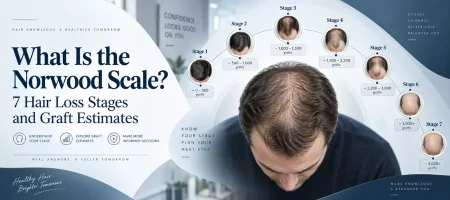
The Norwood Scale, also called the Hamilton-Norwood Scale, is a seven-stage system for classifying male pattern baldness. Stage 1 shows little or no visible recession, while Stage 7 represents extensive loss across the top of the scalp.
The scale is useful, but it is not a graft calculator on its own. It does not measure donor density, hair thickness, scalp size or future progression. Those details still need to be assessed before a realistic transplant plan can be made.
Norwood Scale Stages and Estimated Grafts
The following numbers are broad planning ranges. They are not fixed recommendations because two people at the same stage can need different amounts of hair.
| Norwood Stage | Typical Pattern | Approximate Graft Estimate |
|---|---|---|
| Stage 1 | Little or no visible recession | Usually no transplant |
| Stage 2 | Mild temple recession | 800–1,500 |
| Stage 3 | Deeper frontal and temple recession | 1,500–2,800 |
| Stage 3 Vertex | Frontal recession with crown thinning | 2,000–3,200 |
| Stage 4 | Clear frontal and crown loss | 2,500–4,000 |
| Stage 5 | Larger front and crown areas | 3,500–4,500 |
| Stage 6 | Front and crown largely connected | 4,000–5,500 |
| Stage 7 | Extensive loss across the top | Case by case |
Norwood Stage 1: Little or No Recession
Stage 1 is the starting point. The hairline remains full or close to its original position, with no obvious crown bald spot.
A hair transplant is rarely necessary at this stage. If loss seems rapid, patchy or unusual, finding the cause is more important than using donor grafts before the long-term pattern becomes clear.
Norwood Stage 2: Early Temple Recession
At Stage 2, the temples begin to recede and the hairline may look more mature. The central hairline is usually still relatively strong.
When surgery is appropriate, roughly 800 to 1,500 grafts may be considered. A conservative hairline is important because lowering it too much can increase graft demand and reduce the donor reserve available later.
Norwood Stage 3: More Noticeable Frontal Loss
Stage 3 is where recession becomes easier to recognise. The temples move farther back and the front may develop a stronger M, V or U shape.
Around 1,500 to 2,800 grafts may be used for frontal restoration. The final number depends on forehead width, recession depth, desired density and hair characteristics. Thick or coarse hair often creates stronger visual coverage than very fine hair.
Norwood Stage 3 Vertex: Crown Thinning Appears
Stage 3 Vertex includes thinning or a bald spot around the crown. Crown work can raise the estimate because the area may be wider than it appears in photographs.
A combined front-and-crown plan may involve around 2,000 to 3,200 grafts. If donor supply is limited, many surgeons give the frontal area greater priority and approach the crown more conservatively.
Norwood Stage 4: Front and Crown Both Matter
At Stage 4, frontal recession is deeper and crown loss is more defined, although a band of existing hair usually still separates the two areas.
A typical plan may fall around 2,500 to 4,000 grafts. Rather than spreading them evenly, stronger density is often created in the frontal third and gradually reduced toward the crown.
Norwood Stage 5: Donor Management Becomes Important
By Stage 5, the frontal and crown areas are larger and the bridge between them is narrower. Donor management now becomes central to planning.
Around 3,500 to 4,500 grafts may be discussed in suitable candidates. Some people treat the front and mid-scalp first and leave the crown for a later session, especially when long-term donor preservation is a concern.
Norwood Stage 6: A Large Recipient Area
At Stage 6, frontal and crown loss have largely joined. The key question is how much hair can be removed safely from the donor region.
Around 4,000 to 5,500 grafts may be considered across one or more procedures when donor quality is strong. Full youthful density is rarely realistic, so a mature hairline and stronger frontal coverage often offer the greatest visual benefit.
Norwood Stage 7: Advanced Hair Loss
Stage 7 is the most advanced pattern. Most hair across the top has been lost, leaving a horseshoe-shaped band around the sides and back.
For this reason, a fixed graft estimate is not very useful. Some patients may be suitable for selective frontal restoration or staged surgery, while others may not have enough donor capacity for a worthwhile transplant.
Why Do Graft Estimates Differ at the Same Norwood Stage?
The Norwood Scale shows where hair has been lost, not how much donor hair is available. Hair thickness, curl, scalp size and crown dimensions can all change the estimate.
| Factor | Effect on the Estimate |
|---|---|
| Hair thickness | Coarser hair can create greater visual coverage |
| Hair texture | Wavy or curly hair may appear fuller |
| Donor density | Higher density gives more planning flexibility |
| Scalp size | Larger areas usually require more grafts |
| Hair/scalp contrast | Strong contrast can make thinning more visible |
| Crown size | A wide crown can increase graft demand |
Which Areas Are Usually Prioritised?
When donor hair is limited, surgeons do not necessarily try to cover every thin area equally. The front often receives the greatest attention because it frames the face, while crown density may be kept lighter in advanced cases.
- Hairline for a natural facial frame
- Frontal third for the strongest appearance of density
- Mid-scalp to connect the front with existing hair
- Crown when donor capacity allows
- Donor reserve for possible future loss
How Is the Final Graft Number Calculated?
A final estimate combines recipient-area size, target density and safe donor capacity. Two men may both be Norwood 4, but one can have thick hair and a compact crown while the other has fine hair and a much wider thinning area. Their graft requirements should not automatically be the same.
This is also why online graft calculators have limits. Photographs can help with an initial estimate, but they cannot reliably measure donor density, miniaturisation or how many follicular units can be removed without making the donor area look thin.
What Should You Ask During a Hair Transplant Consultation?
A useful consultation should explain not only the total number of grafts, but also how they will be distributed and whether the donor area can support the plan.
- Which Norwood stage best matches my pattern?
- How many grafts will go to the front, mid-scalp and crown?
- What is my estimated safe donor capacity?
- Is my existing hair likely to keep thinning?
- Would staged surgery make more sense?
- How will the hairline remain natural as I age?
Can the Norwood Scale Predict Future Hair Loss?
Not exactly. The scale describes the visible pattern today; it cannot predict precisely when or whether a person will progress to another stage. Age, family history and miniaturisation can help a specialist discuss likely progression, but the timeline remains individual.
That uncertainty is one reason long-term planning matters. A transplant should still look sensible if more native hair is lost later, and keeping part of the donor reserve available can be as important as improving current density.
Is a Higher Graft Count Always Better?
No. Donor follicles are limited, so a larger number is not automatically a better plan. Excessive extraction can make the back and sides look thin, while poor distribution can waste grafts even when the total sounds impressive.
The best graft count is the number that matches the treatment area, donor capacity and long-term goals. Hairline design, direction, density distribution and safe harvesting influence the final appearance just as much as the number written on the treatment plan.