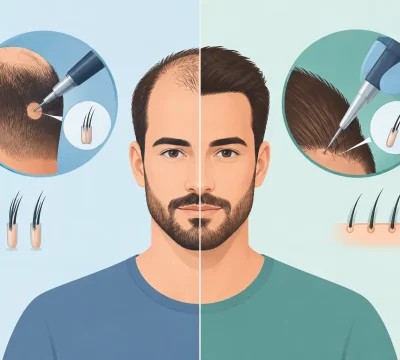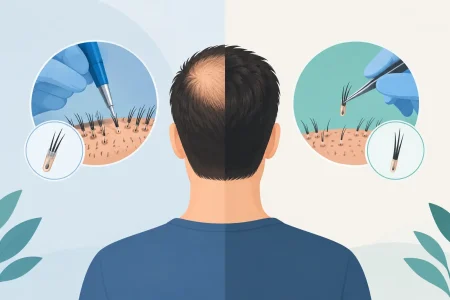
A DHI FUE comparison can sound like a choice between two completely different procedures. In reality, the distinction is more specific: FUE usually describes how grafts are extracted from the donor area, while DHI mainly describes how those grafts are implanted. Knowing that difference helps you ask better questions, compare treatment plans fairly, and choose a route that supports the natural, confidence-building result you want.
For international patients traveling to Turkey, the right method is not simply the one with the most impressive name. It is the method that fits your hair-loss pattern, donor supply, scalp condition, hair characteristics, desired density, and available recovery time. A personal consultation is where those details come together.
Table of Contents
DHI vs. FUE: The Core Difference
Follicular Unit Extraction, or FUE, is a graft-harvesting technique. Individual follicular units are carefully removed from the donor zone, most often at the back and sides of the scalp, where hair is generally more resistant to pattern hair loss. Each graft may contain one, two, three, or sometimes more hairs.
After extraction, the recipient area is prepared with tiny channels or incisions. The team then places the grafts into those sites, paying close attention to angle, direction, and distribution. Those details are what help a new hairline look soft and natural rather than uniform or artificial.
Direct Hair Implantation, or DHI, commonly uses a pen-shaped implanter to place extracted grafts directly into the recipient area. The device can create the opening and implant the graft in a controlled movement. DHI grafts are still often collected using FUE extraction, which is why the phrases DHI and FUE should not always be treated as opposites.
The practical question is usually not, “Is DHI better than FUE?” It is, “Which extraction and implantation approach gives me the safest, most realistic plan for my goals?”
How the Implantation Process Changes
With conventional FUE implantation, the surgeon or clinical team creates recipient channels before graft placement. This can be especially useful when planning coverage over a broader area, rebuilding a receding hairline, or working across the crown. Channel creation allows the team to map direction and spacing across the scalp before implantation begins.
With DHI, grafts are loaded into an implantation pen and placed one by one. This approach can offer precise control in selected areas, particularly when a patient wants to increase density between existing hairs or refine the front hairline. It may also be considered for eyebrows or smaller zones, depending on the treatment plan.
Neither approach automatically produces a denser result. Density depends on the number and quality of available grafts, the size of the recipient area, the health of the scalp, and the need to protect existing native hair. Overpacking a fragile area is not a shortcut to a better outcome. A responsible plan balances visual fullness with graft survival and long-term donor management.
Where sapphire FUE fits in
You may also hear the term sapphire FUE. This usually refers to using sapphire blades to create recipient channels after FUE graft extraction. Sapphire instruments are designed for fine incisions, but they are not a replacement for skilled planning or careful graft handling.
DHI, standard FUE, and sapphire FUE can all be appropriate in different circumstances. The label matters less than the medical reasoning behind the recommendation.
Who May Be a Good Candidate for DHI?
DHI may be considered when the treatment area is relatively focused, such as the hairline, temples, or a zone requiring careful work around existing hair. Some patients with early-to-moderate thinning prefer to preserve their current hairstyle as much as possible while adding strategically placed grafts.
It can also be an option for patients seeking hair restoration in areas beyond the scalp, including beard or eyebrow transplantation. These procedures require their own assessment because graft direction, skin characteristics, and desired density differ significantly from scalp restoration.
However, DHI is not automatically the best choice for every patient. A large area of advanced hair loss may require a broader strategy, often involving a high graft count and detailed coverage planning. In these cases, a conventional FUE or sapphire FUE approach may be more practical, or a specialist may combine techniques according to the area being treated.
Your hair type matters too. Curly, coarse, fine, Afro-textured, and straight hair all create different opportunities and technical considerations. For example, curl pattern can contribute to the appearance of coverage, while curly follicles may require added care during extraction. A one-size-fits-all recommendation does not serve patients well.
Recovery: What Is Similar and What Can Differ?
DHI and FUE share many recovery steps because both involve extracting and transplanting follicular grafts. Small scabs in the recipient area are expected during the early healing period. The donor area also needs gentle care while it recovers.
Most patients can expect visible redness and scabbing in the first days after treatment. The precise timing varies by skin type, procedure extent, and individual healing. Your care team will provide instructions on sleeping position, washing, medication, headwear, sun exposure, exercise, and travel home.
The transplanted hairs commonly shed within the first weeks. This can feel discouraging, but it is a normal part of the hair growth cycle after transplantation. New growth often begins gradually over the following months, with fuller maturation taking much longer. Hair restoration requires patience, and no ethical provider should promise an overnight transformation.
DHI is sometimes described as having less trauma or faster healing. While implantation tools and technique can influence the experience, recovery is still individual. The number of grafts, scalp sensitivity, aftercare habits, and your body’s healing response all matter. It is wiser to focus on a detailed recovery protocol than on broad claims about a method being universally easier.
Questions That Make Your Comparison More Useful
A meaningful consultation should go beyond price and procedure names. Ask how many grafts are realistically available in your donor area and how the team plans to protect it for the future. Ask which areas will be prioritized now and whether further hair loss could affect the appearance of your result later.
You should also understand who performs each stage of the procedure, how the hairline design is personalized, and what aftercare support is available once you return to the United States. Clear answers help you feel prepared before booking international treatment.
It is also reasonable to ask why a team recommends DHI, FUE, or sapphire FUE for your specific case. A trustworthy recommendation should connect the technique to your goals and clinical needs, not rely on a marketing phrase or a one-method-for-everyone approach.
Planning Your Hair Transplant Trip to Turkey
Traveling for hair restoration should feel organized, not uncertain. Before you travel, an online assessment typically reviews photos of your donor and recipient areas, your medical history, current medications, prior procedures, and your goals. A final in-person evaluation can confirm whether the initial plan remains appropriate.
Allow time in your schedule for treatment, the first wash or follow-up visit if recommended, and a comfortable period before flying home. You may feel well enough to travel relatively soon, but you still need to protect the recipient area from pressure, friction, and avoidable exposure.
An all-inclusive care journey can make a major difference for patients coming from abroad. Coordinated airport transfers, accommodations, translation support, treatment scheduling, and recovery guidance reduce the logistical burden so you can focus on your procedure and healing. Just as important, choose a provider that remains available after you return home with clear instructions and responsive follow-up.
Choose the Plan, Not the Trend
The strongest DHI FUE comparison ends with a personalized treatment plan rather than a winner declared for everyone. DHI may be an excellent fit for focused placement and work around existing hair. FUE may be the right foundation for efficient graft extraction and broader coverage. In many cases, the best answer is shaped by both techniques and by the experience of the medical team using them.
At Aslı Tarcan Global, your hair restoration journey begins with understanding what will make you feel like yourself again. Consult our specialists today for a personalized assessment, practical travel guidance, and caring support from your first conversation through recovery.