A hair transplant can look remarkably natural when the plan respects the direction, density, and character of your existing hair. That is why the choice between FUE versus DHI methods should never come down to a trend or a one-size-fits-all promise. It should begin with your donor capacity, hair-loss pattern, goals, and lifestyle.
For international patients traveling to Turkey, the decision also affects practical details: whether shaving is needed, how long the procedure may take, what recovery looks like, and how your treatment team plans the hairline. Both methods can create refined, lasting results when performed by an experienced team. The real question is which approach gives your individual case the best foundation for renewed confidence.
Table of Contents
FUE Versus DHI Methods: The Core Difference
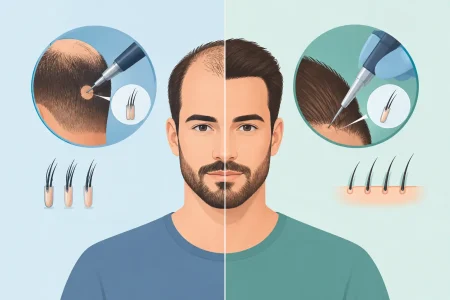
FUE stands for Follicular Unit Extraction. In an FUE procedure, individual follicular units are removed from the donor area, usually at the back and sides of the scalp, using a precise micro-punch. These grafts are then prepared and implanted into tiny recipient channels created in the thinning area.
DHI stands for Direct Hair Implantation. Hair follicles are also typically extracted one by one from the donor area. The difference comes during placement: rather than creating all recipient channels first, the surgeon or trained implantation team places grafts using a specialized implanter pen. This tool can create the opening and implant the follicle in a closely controlled motion.
This distinction matters because FUE describes the extraction technique, while DHI mainly describes the implantation technique. They are often presented as competing treatments, but they share a crucial step: careful graft extraction. In many cases, DHI can be understood as an FUE-based extraction followed by a different implantation approach.
How FUE Is Performed
A conventional FUE hair transplant is valued for its flexibility. After the donor area is prepared and local anesthesia is administered, follicles are individually extracted. The treatment team then creates recipient channels according to the pre-designed hairline and the natural angle of your surrounding hair. Grafts are placed into those channels with close attention to single-hair grafts at the front and fuller graft groupings behind them.
FUE can be an excellent option for patients who need coverage across a larger area, such as a receding hairline combined with crown thinning. It may also be well suited to plans involving a higher graft count, depending on donor quality and the clinical recommendation.
The creation of channels gives the team a clear view of the overall design before implantation begins. This can be useful when building a balanced frontal hairline or distributing grafts throughout broader areas. Sapphire FUE is a variation in which sapphire blades are used to create recipient channels. The suitability of sapphire depends on the plan, not on a claim that one instrument is automatically better for every patient.
How DHI Is Performed
With DHI, extracted follicles are loaded into implanter pens and placed directly into the recipient area. The pen allows the clinician to manage placement angle, direction, and depth at the moment of implantation. This level of control can be particularly helpful in areas where hair direction is highly visible, such as the hairline, temples, or crown.
One practical reason patients ask about DHI is shaving. DHI may allow for a more targeted shave or less visible preparation in selected cases, especially for people with longer existing hair. However, this is not guaranteed. The donor area still needs adequate access for safe extraction, and a partial or full shave may be the most appropriate choice for some treatment plans.
DHI can be appealing when the goal is to work carefully between existing hairs. For patients with early-to-moderate thinning, it may offer a thoughtful approach to adding density while preserving the appearance of the surrounding hair. Yet the method is not a shortcut around donor limitations. A dense-looking result still depends on available grafts, scalp characteristics, and a realistic design.
Density, Naturalness, and the Hairline
Patients often hear that DHI always delivers higher density or that FUE always covers larger areas. Neither statement is complete. Density is influenced by graft availability, the caliber and curl of the hair, the contrast between hair and scalp, the recipient area’s blood supply, and the long-term plan for future loss.
Naturalness is even more dependent on artistry. A convincing hairline should not be too low, too straight, or too dense at the front. It should suit your facial proportions, age, and likely pattern of future hair loss. The direction and angle of each graft matter as much as the number of grafts used.
DHI can offer very precise placement, while FUE channel creation can also support excellent angle and directional control in skilled hands. The better choice is the one that enables the medical team to protect your donor area and execute a design that will still look appropriate years from now.
Recovery and Your Time in Turkey
Both FUE and DHI are minimally invasive hair restoration procedures performed under local anesthesia. Most patients can expect small scabs in the recipient area and temporary redness or sensitivity after treatment. The donor area may feel tender for several days. Your team will provide washing instructions, medication guidance when appropriate, and clear advice on sleeping position, headwear, exercise, sun exposure, and travel.
The visible recovery period varies from person to person, but scabs commonly clear within roughly 7 to 10 days when aftercare instructions are followed. Transplanted hairs often shed in the first weeks. This is a normal part of the growth cycle and should not be mistaken for treatment failure. New growth is gradual, with meaningful changes commonly appearing over several months and maturation continuing for up to 12 months or longer.
Neither FUE nor DHI should be chosen solely because of a promised faster recovery. Both require gentle aftercare and patience. Your travel schedule should leave time for post-procedure checks and a comfortable return journey. For overseas patients, having airport transfers, accommodation, treatment timing, and follow-up guidance coordinated can make the experience far less stressful.
Who May Be Better Suited to Each Method?
FUE may be recommended when a patient requires coverage over a larger surface area, has a suitable donor supply, and benefits from a channel-based implantation plan. It can be used for scalp restoration as well as beard and eyebrow transplantation, although each area requires its own design and graft-handling approach.
DHI may be considered for patients seeking refined placement around the hairline, those with existing hair where careful implantation between strands is desirable, or people who may benefit from a more limited-shave plan. It is also a popular choice for patients focused on detail, but it does not automatically make someone a candidate for a larger number of grafts.
There are situations where either method may be appropriate. Extensive hair loss, weak donor density, certain scalp conditions, or unstable hair loss may require a different strategy, medical treatment, or staged sessions. A responsible consultation should identify these issues early instead of promising an unrealistic result.
Questions to Ask Before You Choose
A useful consultation goes beyond asking, “Which method is best?” Ask how many grafts are safely available, what area should be prioritized, whether your hair loss may continue, and how the proposed hairline will age with you. You should also ask who performs extraction and implantation, how grafts are protected during the procedure, and what aftercare support is available once you return home.
Clear photographs and a detailed medical history help the specialist assess your donor area and create a plan before travel. If you have medical conditions, take regular medications, have scalp concerns, or have previously had a transplant, share that information openly. Personalized planning protects both your health and your expectations.
At Aslı Tarcan Global, international patients can begin with a free online analysis that considers their goals, hair characteristics, and travel needs. From treatment planning to recovery guidance, the purpose is to make each stage feel clear, supported, and centered on you.
Your hair restoration should feel like a considered investment in how you see yourself, not a rushed choice between two labels. Consult a qualified specialist, ask direct questions, and choose the plan that gives your hair, your donor area, and your future confidence the attention they deserve.