A missing tooth can change more than your smile. It can affect how confidently you eat, speak, laugh in photos, and meet new people. Understanding how dental implants are placed can make the decision feel far less intimidating, especially when you are planning care abroad. The process is carefully staged, personalized to your bone and gum health, and designed to create a tooth replacement that looks and functions naturally.
For international patients, the procedure also requires smart timing. Some parts of implant treatment can be completed during one visit, while others need a healing period before the final crown is fitted. A clear plan before you travel helps you protect your health, organize your stay, and return home with realistic expectations.
Table of Contents
How Dental Implants Are Placed: The Planning Stage
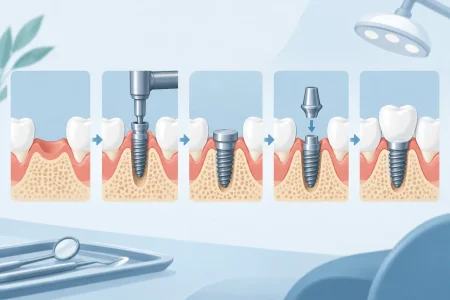
A dental implant is a small, screw-shaped post, usually made of titanium, that replaces the root of a missing tooth. Once it has healed into the jawbone, it supports an abutment and a custom crown. The visible crown is the part that restores your smile; the implant beneath it provides stability.
The process begins with a consultation and detailed examination. Your dental team reviews your medical history, medications, gum condition, bite, and goals for your smile. Digital X-rays and often a 3D CBCT scan show the height, width, and density of available jawbone. These images also help the dentist locate nearby nerves, sinus spaces, and adjacent tooth roots so the implant can be positioned precisely.
This planning stage determines whether an implant can be placed immediately or whether preparatory treatment is needed first. Healthy gums and enough bone are essential. If gum disease is active, it should be treated before surgery. If a tooth is still present but cannot be saved, the dentist evaluates whether it can be removed and replaced with an implant during the same appointment.
For some patients, a bone graft is recommended. Bone can shrink after a tooth has been missing for a long time, particularly in the back of the upper jaw. A graft adds or rebuilds bone so the implant has a stable foundation. This can extend the timeline, but it may improve the long-term result. In the upper back jaw, a sinus lift may also be considered when the sinus floor sits too close to the planned implant site.
Placing the Implant in the Jawbone
On treatment day, the area is numbed with local anesthesia. Patients should feel pressure and movement, but not sharp pain. Depending on individual needs and the agreed treatment plan, sedation options may be available as well.
The dentist makes a small opening in the gum to access the jawbone. Using a sequence of precisely sized instruments, the bone is prepared to receive the implant. The implant post is then placed at the planned angle and depth. Accuracy matters because implant placement affects bite comfort, the appearance of the final crown, and the health of surrounding tissue.
Once the implant is in position, the dentist may place a small healing cap and close the gum around it. In other cases, the implant is fully covered by the gum while it heals. Both approaches are common, and the right choice depends on the implant site, bone quality, gum thickness, and whether other procedures were performed at the same time.
The surgical placement itself is often shorter than people expect. A single straightforward implant may take about an hour, although appointments can take longer when extractions, grafting, or multiple implants are involved. Replacing a full arch is a more complex treatment and follows a different plan than replacing one tooth.
Healing Is When the Implant Becomes Stable
After placement, the jawbone gradually bonds with the implant surface in a biological process called osseointegration. This is what gives an implant its strength. Healing commonly takes several months, though the exact timeframe varies with bone quality, the location of the implant, general health, and whether a bone graft was needed.
Mild swelling, tenderness, and minor bruising are normal in the first few days. Your dentist may recommend pain medication, an antibacterial mouth rinse, and a soft-food diet while the area settles. Brushing and cleaning remain important, but the surgical site must be treated gently according to the aftercare instructions.
Smoking can slow healing and increase the risk of implant complications. Poorly controlled diabetes, untreated gum disease, teeth grinding, and certain medical conditions may also affect suitability or success rates. These are not automatic reasons you cannot receive an implant, but they should be openly discussed before treatment. A responsible plan is always built around your individual health, not a one-size-fits-all timeline.
Some patients may be candidates for immediate loading, meaning a temporary tooth is attached shortly after implant placement. This can be especially appealing for a front tooth or a full-arch restoration. However, immediate loading is not right for everyone. The implant must achieve strong initial stability, the bite must be carefully controlled, and bone and gum conditions need to support it. A temporary tooth can improve appearance during healing, but it is not permission to bite hard foods before your dentist says it is safe.
The Abutment and Final Crown
When the implant has healed securely, the next step is connecting the abutment. This is the small connector that sits between the implant post and the final crown. If the implant was covered by gum tissue during healing, a brief appointment is needed to expose it and place a healing component before the abutment is fitted.
Your dentist then takes a digital or physical impression of the implant position, surrounding teeth, and bite. This information is used to create a custom crown designed for your smile. The dental laboratory matches the crown’s shape, size, and color to your natural teeth whenever possible.
At the final fitting, the dentist checks how the crown looks, feels, and meets the opposing teeth. It may be secured with dental cement or a small screw, depending on the restoration design. The goal is a tooth that feels comfortable, supports everyday chewing, and blends naturally with your smile.
An implant crown is durable, but it still needs care. Brush twice daily, clean between teeth or around the implant as instructed, and attend regular dental checkups. Unlike natural teeth, an implant cannot develop a cavity, but the gum and bone around it can become inflamed without good hygiene. Protecting those tissues is key to preserving your result.
Planning Dental Implant Treatment in Turkey
For patients traveling from the US or elsewhere, the treatment schedule matters just as much as the clinical steps. A consultation before travel allows the dental team to review your case, discuss scans or photographs, and outline whether you may need one trip or more than one. Complex cases, grafting, and final crowns after a healing period often require staged visits.
Your first visit may include examination, imaging, extractions if needed, implant placement, and a temporary restoration where appropriate. You should also allow recovery time before flying home rather than scheduling travel immediately after surgery. Your provider can advise you based on the scale of treatment and your health history.
At Aslı Tarcan Global, international dental care is organized as a supported treatment journey, with individualized planning, travel coordination, and follow-up guidance. That structure can be especially reassuring when you are arranging treatment in another country and want to focus on your recovery rather than logistics.
Before committing, ask direct questions about the implant system, the dentist’s proposed timeline, whether grafting is included, what temporary restoration you will receive, and how aftercare will work once you are home. You should also share any medical conditions, medication changes, allergies, and previous dental records. Clear communication helps prevent surprises and gives your dental team the information needed to plan safely.
A dental implant is not simply a replacement tooth. It is a carefully planned foundation for eating comfortably, speaking freely, and smiling without holding back. Start with a personalized assessment, give healing the time it deserves, and choose a care team that will guide you through each stage with attention and clarity.