Some people can wrap a hair tie around their ponytail three times and still struggle to keep it secure. Others need a stronger band just to gather their hair. That difference often comes down to hair density, although strand thickness plays a part too. Knowing the difference helps you choose products that actually suit your hair.
Hair density describes how many strands grow within a given area of your scalp. It helps explain why one haircut looks full on one person but falls flat on another. It can also help you notice changes over time.
Table of Contents
What Is Hair Density?
Hair density is the number of hair strands growing per square centimeter of scalp. It is different from the size of an individual strand. Someone can have hundreds of fine hairs packed into a small area, while another person has fewer strands that are much thicker.
Professionals measure density by examining and counting hairs in defined scalp areas. At home, you can get a general idea by looking at scalp visibility, your part line, and how much hair gathers into a ponytail. Together, these clues can be useful.
What Is Low Density Hair?
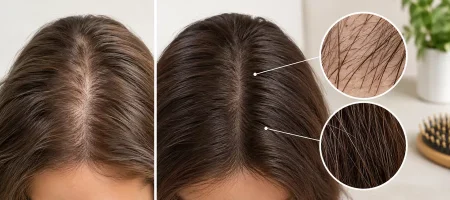
Low density hair means fewer strands grow within a given area of the scalp. The skin may be visible between sections, particularly along the part or near the temples. A ponytail might feel small even when the individual strands are coarse and strong.
Low density is not automatically a sign of hair loss. Some people have always had fewer follicles than others. What matters is whether the amount of hair has changed from your usual baseline. A naturally visible part is different from one that has become noticeably wider over six months.
What Is High Density Hair?
High density hair has a relatively large number of strands growing close together. It may take time to wet thoroughly, section, or dry, simply because there is more hair to work through. The scalp is usually difficult to see without deliberately separating the strands.
Having high density does not guarantee stronger or healthier hair. Individual strands can still break, become dry, or develop damage. People with very full hair often benefit from working in sections when applying conditioner or detangling, rather than piling on more product at once.
Low vs. Medium vs. High Hair Density: Key Differences
Daily observations offer a useful starting point, but hair color, curl pattern, and strand diameter can change how full the same number of hairs appears. Use this table as a guide, not a diagnosis.
| Feature | Low Density | Medium Density | High Density |
|---|---|---|---|
| Scalp visibility | Often easy to see | Mainly visible along a part | Usually needs separating |
| Ponytail appearance | Smaller bundle | Moderate bundle | Fuller bundle |
| Styling challenge | Creating volume | Keeping balance | Managing bulk |
| Product approach | Light application | Adjust to texture | Apply evenly in sections |
How Can You Tell If You Have Low or High Density Hair at Home?
You do not need a microscope to notice broad patterns. Check clean, dry hair in ordinary lighting, then compare what you see with photographs from earlier months.
- Look at your natural part. A wide area of visible scalp may suggest lower density, especially if the part has widened over time.
- Check different scalp areas. Compare the crown, temples, and back of your head. Density is not always the same everywhere.
- Gather your hair into a ponytail. A small bundle can suggest lower density, but length and strand thickness affect the result.
- Compare photographs consistently. Use the same lighting, hairstyle, and angle. Changes over several months are more informative than daily checks.
What Is the Difference Between Hair Density and Hair Thickness?
Hair density counts strands within an area. Hair thickness usually refers to the diameter of one strand, although people sometimes use the word to describe overall fullness. These are separate features, which is why thick hair does not necessarily mean high density hair.
Imagine two heads with the same number of hairs. If one has wider strands, it may look fuller despite having the same density. Texture also changes visual coverage: curls create space and volume, while straight hair tends to lie closer to the scalp. The distinction matters when choosing a haircut or evaluating possible thinning.
How Do Professionals Measure Hair Density?
A dermatologist may use trichoscopy, which magnifies the scalp and allows hairs to be counted within a known area. Some assessments also measure shaft diameter and look for miniaturization, when follicles produce increasingly fine strands. These details help separate naturally sparse hair from certain forms of progressive loss.
There is no universal number that labels everyone as low or high density. Counts vary by scalp region, age, population, and measurement method. A professional assessment is most useful when compared with your hair loss history and the pattern seen across your scalp.
What Causes Naturally Low or High Hair Density?
Genetics has a major influence on the number and distribution of hair follicles. Age also matters, since some follicles gradually produce finer hairs or stop growing visible strands. Hormonal changes, illness, nutritional problems, and certain scalp conditions may reduce apparent density over time.
Hair routines can affect how much hair you seem to have without changing your natural follicle count. Tight hairstyles may contribute to traction-related loss, while bleaching and rough brushing can cause breakage. Neither is the same as being born with fewer follicles.
Hair Density vs. Hair Loss: How Are They Different?
A person may have naturally low density for their entire life without losing hair abnormally. Hair loss describes a change, often involving increased shedding, reduced coverage, or a shift in hair growth. The difference is easier to understand when you focus on progression.
| Observation | Naturally Low Density | Possible Hair Loss |
|---|---|---|
| Part line | Similar for years | Becoming wider |
| Hairline | Long-standing shape | Gradual recession or new gaps |
| Ponytail | Always relatively small | Noticeably smaller than before |
| Scalp coverage | Stable pattern | Progressive or sudden change |
Sudden patches or scalp inflammation need medical review. Learn more about early signs of hair thinning.
Can Curly Hair Have Low Density?
Absolutely. Curl pattern and density describe different qualities. Curly strands can create impressive volume even when fewer hairs grow per square centimeter. Straight hair may reveal more scalp despite having a similar strand count. Neither texture tells the whole story on its own.
This matters in hair restoration too. The shape and direction of curly follicles require careful planning, separate from the question of density. Readers exploring texture-specific treatment can learn more about Afro hair transplantation.
How Does Hair Density Affect Haircuts and Styling?
A haircut should work with the amount of hair you have, not against it. On low density hair, heavy layering can make the ends look sparse. A blunt edge may create a fuller outline. With high density hair, carefully placed layers can reduce bulk while preserving movement.
| Hair Density | Styling Goal | Useful Approach |
|---|---|---|
| Low | Create a fuller outline | Blunt cuts and light products |
| Medium | Keep shape and movement | Balanced layers and flexible styling |
| High | Manage volume and weight | Sectioned styling and controlled layers |
A good stylist also considers strand thickness, curl pattern, and how much time you want to spend on your hair each morning.
How Can You Make Low Density Hair Look Fuller?
A few practical changes can improve the appearance of fullness without promising new follicle growth. The goal is to keep the hair light and create shape where it matters.
- Choose a suitable cut. A blunt bob or tidy perimeter can make the ends appear denser.
- Avoid heavy product layers. Too much oil or cream may flatten fine, low density hair.
- Dry gently for lift. Direct airflow at the roots on a moderate setting, and avoid excessive heat.
- Try a different part. Shifting it slightly may help the hair sit with more natural volume.
Can Hair Transplantation Improve Hair Density?
Hair transplantation can redistribute suitable follicles from a donor area to parts of the scalp with reduced coverage. The aim is improved visual density, not an unlimited increase in total hair count. Planning depends on donor supply, existing hair, scalp health, and the cause of thinning.
Techniques such as FUE hair transplantation may be considered after assessment. Transplantation is not a routine answer to naturally fine or low density hair, and active hair loss may need to be managed before surgery is considered.