A beautiful smile should still feel like your own. That is why a thoughtful veneers crowns comparison matters before you make treatment plans abroad. Veneers and crowns can both improve tooth color, shape, and confidence, but they solve different dental concerns. The right choice depends on how healthy and strong each tooth is, how your bite works, and what you want your smile to look and feel like years from now.
For international patients, the decision also affects your timeline in Turkey. Some cases can be completed efficiently in one planned visit, while others need staged care, especially if underlying dental issues need attention first. A personalized online consultation helps turn a broad smile goal into a clear, realistic treatment plan.
Table of Contents
Veneers vs. Crowns: The Essential Difference
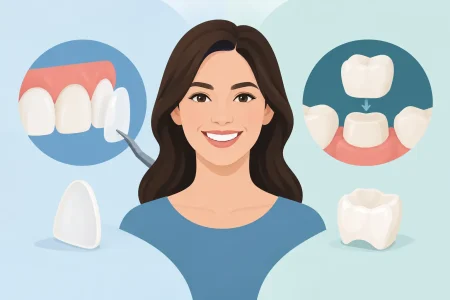
A veneer is a thin, custom-made shell bonded to the front surface of a tooth. It is primarily a cosmetic treatment, designed to improve what people see when you smile. Veneers may be recommended for teeth that are stained, slightly chipped, unevenly shaped, mildly spaced, or worn at the edges.
A crown covers the entire visible portion of a tooth above the gumline. It is often a restorative solution first and an aesthetic solution second. A crown can protect a tooth that has a large filling, significant decay, a fracture, extensive wear, or a weakened structure after root canal treatment. It can also restore the shape and function of a tooth that no longer has enough healthy enamel to support a veneer reliably.
Both options can be created in lifelike materials such as porcelain or advanced ceramic. Both can be color-matched and shaped to complement your facial features. The key distinction is coverage: veneers enhance the front of a healthy tooth, while crowns provide full coverage and structural protection when a tooth needs more support.
When Veneers May Be the Better Choice
Veneers are often suited to patients whose teeth are fundamentally healthy but whose smiles do not reflect how they want to look. If your concern is cosmetic rather than structural, a veneer may preserve more natural tooth tissue than a full crown.
They can create a balanced smile by addressing several visible concerns at once. For example, a patient with discoloration that does not respond well to whitening, minor enamel wear, and small gaps between front teeth may benefit from a carefully planned set of veneers. The result is not simply whiter teeth. It is a more harmonious smile, with proportions designed around the lips, gums, and facial profile.
However, veneers are not a universal answer to every cosmetic concern. If a tooth has a large old filling, active decay, a deep crack, or very limited remaining enamel, bonding a thin veneer may not be the most secure long-term choice. Patients who clench or grind their teeth may also need additional bite protection, such as a night guard, regardless of whether they choose veneers or crowns.
What Preparation for Veneers Involves
Many veneer cases require a small amount of enamel shaping so the final teeth look natural rather than bulky. The amount varies according to tooth position, desired color change, and the material selected. Some patients may be candidates for minimal-prep or no-prep approaches, but these are not automatically better. If a tooth already projects forward, adding material without enough space can create an unnatural contour.
Because enamel reduction is permanent, you deserve a clear explanation of how much preparation is planned and why. High-quality cosmetic dentistry should not be rushed into a one-size-fits-all design.
When Crowns Are the Better Investment
Crowns are usually recommended when restoring tooth strength is as important as improving appearance. Think of a crown as a protective new outer layer for a tooth that has been compromised but can still be preserved.
A crown may be the right choice when there is extensive decay or a large filling, when a tooth is broken or severely worn, or after root canal treatment. It may also be used as part of an implant restoration, where the crown becomes the visible replacement tooth attached to the implant.
For a front tooth, modern ceramic crowns can be highly aesthetic. For back teeth, material selection may focus more on bite strength and durability. Your dentist will consider the location of the tooth, the amount of pressure it receives, your natural tooth shade, and whether you have habits such as clenching.
Crowns require more tooth preparation than veneers because they wrap around the tooth. That trade-off can be worthwhile when the tooth needs protection. Placing a veneer on a structurally weak tooth simply because it sounds less invasive can lead to avoidable complications later.
Appearance, Longevity, and Daily Care
A well-designed veneer or crown should blend naturally with your smile. The best result is not always the brightest possible white. It is a shade and shape that look healthy, suit your complexion, and feel authentic when you speak and laugh.
Neither treatment is maintenance-free. Porcelain and ceramic resist staining better than natural enamel, but the edges where restorations meet natural teeth still require excellent brushing and flossing. Gum health is essential. Bleeding gums, untreated periodontal disease, and untreated cavities should be addressed before cosmetic work begins.
Longevity varies from person to person. Material quality, bite forces, oral hygiene, smoking, grinding, and regular dental checkups all influence how long veneers and crowns last. Avoid biting hard objects, opening packaging with your teeth, or chewing ice. These habits can damage natural teeth as well as restorations.
How the Treatment Journey Is Planned in Turkey
For patients traveling from the US or other countries, dental care should begin before the flight. Share recent X-rays if you have them, along with clear photos and a description of your goals. During your online assessment, the dental team can discuss whether veneers, crowns, implants, whitening, or another treatment may be appropriate.
Once you arrive, an in-person examination confirms the plan. This may include digital imaging, bite evaluation, gum assessment, and a discussion of your preferred tooth color and smile character. If treatment proceeds, the teeth are prepared as needed, impressions or digital scans are taken, and temporary restorations may be placed while your custom restorations are created.
At the fitting appointment, your dentist checks the shape, shade, bite, and comfort before final placement. This stage matters. A restoration should not only photograph beautifully. It should allow you to speak clearly, chew comfortably, and close your teeth naturally.
A coordinated dental travel plan also gives you time for appointments without feeling rushed. Aslı Tarcan Global can help international patients organize the practical side of their visit, from treatment scheduling to accommodation coordination and recovery guidance. Your plan should include enough time for final checks before you travel home.
Questions to Ask Before Choosing
Before committing to either option, ask your dentist whether the tooth is healthy enough for a veneer, whether a crown is needed to protect it, and how your bite may affect the result. Ask which material is being recommended, how much natural tooth structure will be prepared, and what aftercare will help protect your investment.
It is also wise to ask whether any issues should be treated first. Whitening, gum care, cavity treatment, orthodontics, or replacement of failing restorations may change what will deliver the most stable and attractive result. A confident smile is built on healthy foundations, not just a new surface.
The best choice is the one that respects your natural teeth while helping you feel comfortable showing your smile again. Consult our specialists today to receive an individualized assessment and begin planning a dental journey that supports both your confidence and your long-term oral health.