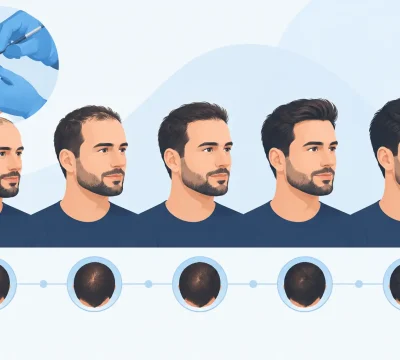
A high hairline can change the way the entire face is perceived. For some people, it has been part of their appearance since childhood; for others, gradual recession around the temples or frontal area makes the forehead look larger over time. Whatever the reason, forehead reduction can help create a more balanced relationship between the hairline, eyebrows, and other facial features. Today, several options are available, ranging from surgical hairline advancement to hair transplantation and temporary cosmetic solutions.
Choosing the right forehead reduction approach is less about finding the procedure that lowers the hairline the most and more about identifying what suits the individual. Hair density, scalp flexibility, forehead shape, donor capacity, age, and future hair-loss risk can all influence the result. A natural-looking outcome should make the face feel more proportionate without creating a hairline that looks unusually low, overly straight, or disconnected from the surrounding hair.
Table of Contents
Forehead Reduction: Why Can a Hairline Look Too High?
A high-looking hairline does not always mean that the forehead itself is unusually large. Genetics play a major role, and some people naturally have more distance between the eyebrows and frontal hairline. Temple recession can also widen the upper face, while frontal thinning may gradually expose more forehead. Hairstyles that pull the hair tightly backward can make these proportions appear even more noticeable.
For effective forehead reduction, the reason behind the high hairline should be identified first. Someone with a naturally high but dense hairline may require a different solution from a person whose hairline has moved backward because of progressive hair loss. Understanding this distinction helps prevent treatments that solve the immediate cosmetic concern without accounting for future changes.
| Cause of a High Hairline | Typical Appearance | Possible Approach |
|---|---|---|
| Naturally high hairline | Stable but positioned higher on the forehead | Hair transplant or hairline lowering |
| Temple recession | Wider upper forehead | Temple restoration |
| Frontal thinning | Increasingly visible forehead | Hair restoration planning |
| Hairstyle-related tension | Thinning around the front or temples | Styling changes and medical assessment |
| Progressive hair loss | Gradually receding hairline | Long-term hair-loss and restoration plan |
Forehead Reduction: What Options Are Available?
There is no single forehead reduction technique that works equally well for everyone. Permanent procedures aim to physically lower or reconstruct the hairline, while temporary options change the way the forehead is framed.
- Hair transplantation can create a new, lower frontal hairline using follicles from a suitable donor area.
- Hairline lowering surgery can move the existing hair-bearing scalp forward.
- Temple transplantation can reduce the appearance of a wide forehead.
- Bangs, fringes, and layered hairstyles can visually shorten the upper face.
- Hairline powders and cosmetic contouring can temporarily create the appearance of a lower hairline.
- Selected patients may benefit from combining more than one approach.
Forehead Reduction: How Can a Hair Transplant Lower the Hairline?
Hair transplantation is one of the most customizable forehead reduction options. During the procedure, healthy follicles are taken from an appropriate donor region and placed into areas below or around the existing hairline. Instead of simply drawing a lower horizontal border, the hairline can be shaped according to facial width, temple structure, existing hair direction, and individual proportions.
This flexibility is particularly useful for people who need both central hairline lowering and temple restoration. Hair transplantation does not create an immediate final result because transplanted follicles require time to establish themselves and grow. However, once growth develops, the new hairs can blend with the existing hair and make the forehead look noticeably shorter.
Forehead Reduction: How Does Hairline Lowering Surgery Work?
Hairline lowering surgery, sometimes referred to as surgical forehead reduction, takes a different approach. Rather than adding new follicles, the surgeon advances the existing hair-bearing scalp toward the forehead. An incision is made along the frontal hairline, a carefully determined section of forehead skin is removed, and the scalp is repositioned.
One advantage is that the position of the hairline changes immediately. However, suitability depends heavily on scalp flexibility, the stability of the existing hairline, healing characteristics, and the risk of future recession. Because an incision is involved, scarring must also be part of the discussion before choosing this forehead reduction method.
Forehead Reduction: Hair Transplant or Hairline Lowering Surgery?
Both procedures can achieve a smaller-looking forehead, but their strengths are different. Hair transplantation offers precise control over hairline shape and density, while surgical hairline lowering moves the existing hairline forward in a single procedure. Neither approach should be chosen simply because it appears faster or more dramatic.
| Feature | Hair Transplant | Hairline Lowering Surgery |
|---|---|---|
| How the hairline changes | New follicles create a lower border | Existing scalp is advanced |
| Result timing | Develops gradually | Position changes immediately |
| Donor follicles required | Yes | Usually not for the main advancement |
| Temple reshaping | Highly customizable | More limited |
| Incision along frontal hairline | Not required in the same form | Usually required |
| Major planning factor | Donor capacity | Scalp flexibility |
Forehead Reduction: Why Are the Temples Important?
The central hairline receives most of the attention during forehead reduction, but the temples can be just as important. Receded or naturally open temples can make the forehead appear wider even when its vertical height is not excessive. In some cases, subtly restoring the temple corners creates a more significant visual improvement than dramatically lowering the middle of the hairline.
Temple transplantation requires precise attention to direction because natural temple hairs usually grow at flatter angles than hair at the top of the scalp. Creating an abrupt or overly dense transition can make the result obvious. Soft density and carefully planned angles generally produce a more convincing frame around the forehead.
Forehead Reduction: Who May Be a Suitable Candidate?
A suitable candidate for permanent forehead reduction generally needs realistic expectations and anatomy that supports the chosen procedure. For transplantation, the donor area should contain enough healthy follicles to create the planned hairline without compromising future options. For hairline lowering surgery, adequate scalp mobility and a stable frontal hairline are particularly important.
Age and family history of hair loss also deserve attention. A person may currently have strong frontal density but still be at risk of recession later. Creating an excessively low hairline at a young age can make future hair loss harder to manage. Conservative planning often produces results that remain more natural over time.
Forehead Reduction: What Should Be Checked Before Treatment?
Before committing to a permanent forehead reduction procedure, the hairline should be assessed as part of the entire face rather than as an isolated feature.
- Identify whether the high hairline is natural or caused by hair loss.
- Evaluate the stability of the frontal and temple areas.
- Check donor density when transplantation is being considered.
- Assess scalp flexibility for surgical advancement.
- Consider forehead width as well as height.
- Plan the hairline according to age and facial proportions.
- Discuss potential future recession before choosing a very low hairline.
- Review recovery expectations and the possibility of visible scarring.
Forehead Reduction: Why Does Hairline Design Matter So Much?
Successful forehead reduction depends heavily on hairline design. A naturally occurring hairline rarely forms a perfectly straight line. It contains small irregularities, softer areas at the edges, differences in density, and gradual transitions toward the temples. Recreating these characteristics can make a reconstructed hairline much less noticeable.
Position is equally important. The lowest possible hairline is not necessarily the most attractive one. Facial width, eyebrow position, age, temple shape, and existing hair density should all influence the design. A slightly conservative hairline that blends naturally with the face often looks better than one that has been lowered aggressively.
Forehead Reduction: How Much Can the Hairline Be Lowered?
There is no universal measurement for forehead reduction because anatomy varies considerably. In hair transplantation, donor availability, hair thickness, the size of the recipient zone, and the density required along the new hairline limit how far the design can realistically move forward. A larger area requires more follicles to avoid an artificial or sparse appearance.
With surgical hairline lowering, scalp flexibility becomes one of the main determining factors. Trying to force the hairline significantly farther than the tissue naturally allows may not be appropriate. In either procedure, the goal should be facial balance rather than reaching a predetermined number of centimeters.
Forehead Reduction: What Does Recovery Look Like?
Recovery depends on the chosen forehead reduction procedure. After a hair transplant, temporary redness, small crusts, mild swelling, and shedding of transplanted hair shafts may occur. New growth develops gradually rather than immediately. Patients generally receive instructions regarding washing, sleeping position, exercise, and protection of the recipient area.
Hairline lowering surgery has a different recovery pattern because an incision must heal. Swelling, tightness, temporary numbness, and sensitivity around the frontal scalp may occur during the early period. Following postoperative instructions carefully is important in either procedure because the healing phase contributes to the final cosmetic appearance.
Forehead Reduction: How Long Does It Take to See the Final Result?
Hairline lowering surgery changes the position of the hairline immediately, although swelling and the healing incision mean that the final appearance should not be judged right away. As the tissues settle and the incision matures, the new forehead proportions become easier to evaluate.
Hair transplantation requires considerably more patience. Some transplanted hairs may shed before entering a new growth phase, and visible density develops gradually over the following months. The forehead reduction effect becomes more convincing once the new hair has enough length and density to blend naturally with the surrounding hair.
Forehead Reduction: Can a Hairstyle Make the Forehead Look Smaller?
Not everyone who dislikes a high hairline needs a medical procedure. Bangs, curtain fringes, curls, textured layers, and side parts can significantly change the amount of forehead that remains visible. Adding volume around the temples may also reduce the appearance of width.
Hairstyling does not physically provide forehead reduction, but it can be useful for experimenting with proportions before considering permanent treatment. People who already have fragile frontal hair should avoid styles that repeatedly pull tightly on the hairline, since excessive tension may contribute to further thinning.
Forehead Reduction: Can Makeup and Hairline Products Help?
Hairline powders, fibers, and cosmetic contouring can temporarily make a high hairline appear less prominent. Darker tones placed carefully around the upper forehead can create the illusion of a shorter space between the eyebrows and hairline. These products can also soften visible gaps around the temples.
The advantage is that the effect is completely adjustable. A person considering permanent forehead reduction can experiment with different hairline shapes before committing to surgery or transplantation. The limitation, of course, is that cosmetic products do not change the actual hairline and must be reapplied.
Forehead Reduction: Can Results Look Natural?
Natural results are possible when the procedure respects existing facial and hair characteristics. With transplantation, follicle direction, graft selection, density transitions, and subtle irregularities all contribute to a believable new hairline. With surgical advancement, incision placement and the relationship between the repositioned hairline and surrounding features are equally important.
The best forehead reduction result should not make people focus on the hairline itself. Instead, the face should simply appear more balanced. When someone immediately notices that a hairline has been artificially lowered, the design may have been too aggressive or insufficiently adapted to the individual.
Frequently Asked Questions
Forehead Reduction: Is a Hair Transplant Permanent?
Follicles used for transplantation are generally selected from areas considered more resistant to common patterns of hair loss. Once successfully established, these follicles are intended to provide long-term hair growth in their new position.
However, transplanted hair does not stop untreated native hair from changing. Long-term forehead reduction planning should therefore consider future recession around the transplanted area, particularly in younger patients.
Forehead Reduction: Does Hairline Lowering Leave a Scar?
Because hairline lowering surgery requires an incision, some degree of scarring is expected. How noticeable it becomes depends on the surgical technique, individual healing, hair density around the incision, and the characteristics of the patient’s skin.
This should be discussed before treatment rather than treated as an afterthought. Hair transplantation does not involve the same type of long frontal incision, which may influence the choice for someone particularly concerned about scars.
Forehead Reduction: Can Women Have Their Hairline Lowered?
Women with a naturally high hairline may be suitable for either transplantation or hairline lowering surgery depending on their anatomy. Hair transplantation can be particularly useful when the temple points also need reshaping or when subtle adjustment is preferred.
If frontal thinning is present, its cause should be evaluated before permanent forehead reduction. Diffuse hair loss may affect both the recipient and donor regions, making careful assessment especially important.
Forehead Reduction: Which Procedure Provides the Fastest Change?
Surgical hairline lowering provides an immediate positional change because the existing hairline is physically advanced. Hair transplantation takes longer because newly transplanted follicles must progress through their natural growth cycle.
Speed should not be the only deciding factor. The most appropriate forehead reduction method is the one that matches the person’s scalp characteristics, hair-loss pattern, desired hairline shape, and long-term needs.
Forehead Reduction: Which Option Is Best for a High Hairline?
There is no single best option for every high hairline. Someone with a naturally high, dense, stable hairline and appropriate scalp flexibility may consider surgical advancement. A person who wants detailed reshaping, temple restoration, or additional frontal density may find hair transplantation more adaptable.
The right forehead reduction choice comes from evaluating facial proportions, donor resources, scalp anatomy, current hair density, possible future hair loss, and the desired degree of change together. A personalized plan is more likely to create a smaller-looking forehead while preserving a natural appearance over time.